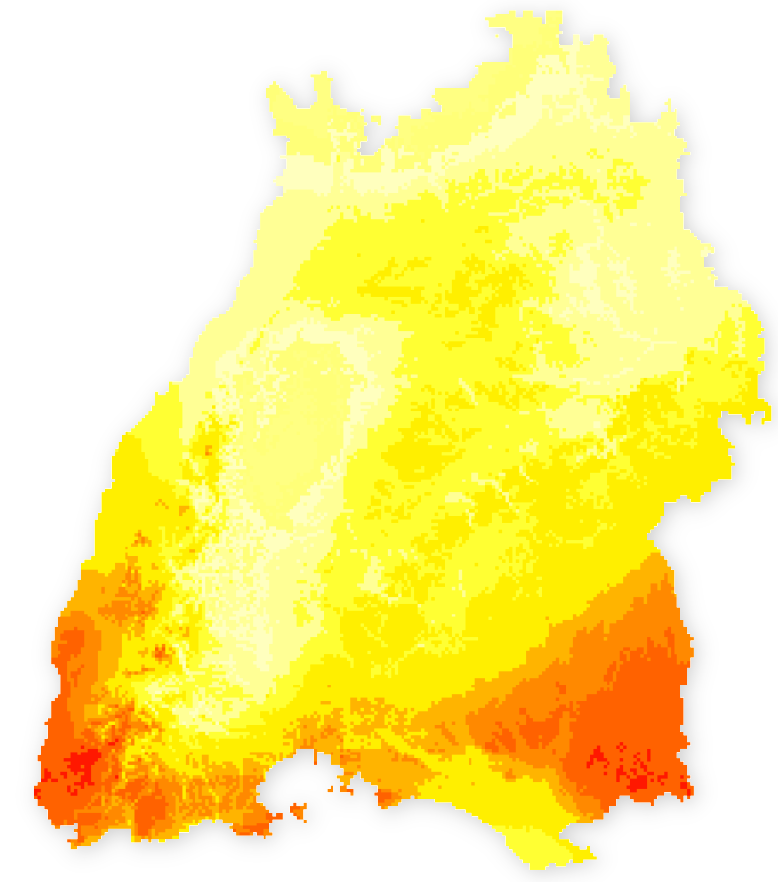







Standortkarte Baden-Württemberg
Kompetenzzentrum Obstbau Bodensee
(Forschungsanlage mit statischem und nachgeführtem System)
apfel
Obsthof Bernhard
(Praxisanlage mit statischem System)
apfel
Landwirtschaftliches Technologiezentrum Augustenberg
(Forschungsanlage mit statischem und nachgeführtem System)
apfel birne
Staatliche Lehr- und Versuchsanstalt für Wein- und Obstbau Weinsberg
(Forschungsanlagen, zwei statische Systeme (Beerenobst-PV und Süßkirsche-PV))
himbeere johannisbeere johannisbeere_schwarz erdbeere heidelbeere kirsche
Obsthof Vollmer
(Praxisanlagen mit zwei statischen und einem nachgeführten System)
apfel zwetschge birne
Staatliches Weinbauinstitut Freiburg
(Viti-PV-Forschungsanlage mit statischem und zwei nachgeführten Systemen)
trauben
Temporäre PV-Nutzung von Aufforstungsflächen
(Forst-PV-Forschungsanlage mit statischem System)
tannen
Agri-PV mit senkrechten bifazialen Modulen – Landnutzung – Biodiversität – Akzeptanz – Netzdienlichkeit – Kooperation
(Praxisanlage, vertikales System)
ackerbau grasland
Agri-PV auf Dauergrünland
(Aulendorf, Freiflächenanlage (Referenzanlage))
grasland
Agri-PV auf Dauergrünland
(Eberhardzell, nachgeführte Anlage mit opaken PV-Modulen)
grasland
Agri-PV auf Dauergrünland
(Epfendorf, vertikale Anlage)
grasland
Agri-PV auf Dauergrünland
(Löffingen, hoch aufgeständerte statische Anlage)
grasland
Agri-PV auf Dauergrünland
(Rottweil, vertikale Anlage)
grasland
Kombination Photovoltaik und Freiland-Legehennenhaltung
(Freiflächenanlage mit Legehennenhaltung)
huhn
Kombination Photovoltaik und Freiland-Legehennenhaltung
(Freiflächenanlage mit Legehennenhaltung)
huhn
Universität Hohenheim
(Forschungsanlage mit statischem System)
ackerbau

The Model Region and its sub-projects

»Model Region Agrivoltaics for Baden-Württemberg« is a project led by the Fraunhofer Institute for Solar Energy Systems (ISE). It aims to drive the expansion of agrivoltaics in the south-west of Germany. The first implementation phase (2022-2024) was launched at the end of 2021, funded by the Baden-Württemberg Ministry for the Environment, Climate and Energy Sector and the Baden-Württemberg Ministry of Food, Rural Affairs and Consumer Protection. Five agrivoltaic pilot facilities were set up with ongoing scientific monitoring and evaluation. The research focus in this phase was on pome fruit (apple, pear), stone fruit (plum) and berries.

In the second implementation phase (2025-2026) the focus will extend beyond fruit cultivation, with sub-projects combining photovoltaic systems on grasslands, on arable farming and in combination with livestock farming, winegrowing and reforestation.

Standorte

The map shows the average annual global radiation in Baden-Württemberg from 1981 to 2000. The darker the colour, the higher the solar radiation that falls on a horizontal surface. Source: Deutscher Wetterdienst.